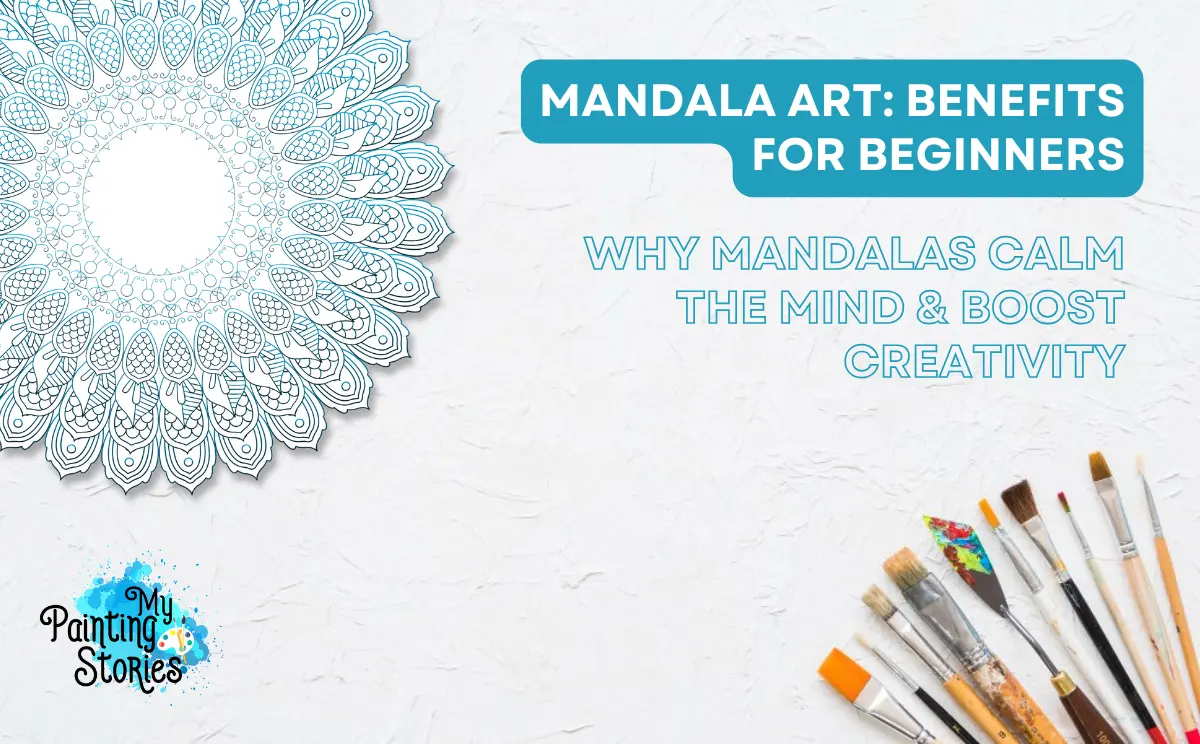
Mandala art is an ancient art form rooted in symmetry, geometry, and spiritual mindfulness. Derived from the Sanskrit word for “circle,” a mandala represents wholeness, unity, and the cosmos.
Today, artists and beginners worldwide practice mandala painting as both a creative hobby and a form of active meditation
What Is Sacred Geometry in Mandala Art?
Sacred geometry refers to the geometric patterns and shapes that repeat throughout nature—from the petals of a flower to the structure of galaxies. In mandala painting, sacred geometric forms like the Torus Yantra or 64 Tetrahedron serve as visual symbols of balanced energy flow and universal connection.
Central Grid Line (Center Axis) ➔ Concentric Circles (Consciousness Expansion) ➔ Radiating Petals / Symmetry (Harmony)
Key Sacred Mandala Symbols & Their Meanings
| Symbol | Geometric Shape | Core Meaning |
|---|---|---|
| Circle | 360-degree loop | Unity, wholeness, and infinite energy |
| Square | 4 equal sides | Stability, grounding, and physical reality |
| Lotus Petal | Organic curve | Spiritual growth and purity |
| Torus Yantra | Dual vortex | Dynamic, balanced energy flow |
Step-by-Step: Drawing Your First Mandala
- Draw a Grid Base: Using a compass and protractor, draw concentric circles starting from a center point, divided into 10° or 15° radial angles.
- Fill the Inner Core: Start from the center circle with basic shapes like teardrops, dots, or small lotus petals.
- Expand Layer by Layer: Repeat identical patterns along each ring segment to maintain symmetrical balance.
- Add Contrast & Detail: Use fine-liner pens (0.1mm to 0.5mm) or metallic inks to shade alternate sections for visual depth.
Key Takeaway :
Mandala art uses sacred geometry to structure symmetrical patterns around a central point, helping practitioners improve concentration and reduce stress through repetitive, structured strokes.
FAQ
Sacred geometry provides the structural framework for mandala art. By using repeating geometric forms found in nature—such as concentric circles, radial symmetry, and central axes—mandalas visually represent universal balance, unity, and energy flow.
No advanced tools are needed to start. Beginners only need a pencil, a standard ruler, a compass, and a protractor to set up the circular grid angles. Once your radial grid is drawn, you can fill the sections using basic fine-liner pens (0.1mm–0.5mm) or gel pens.